
CLEANER MOUNTAINS
BUBBLE WOUH!
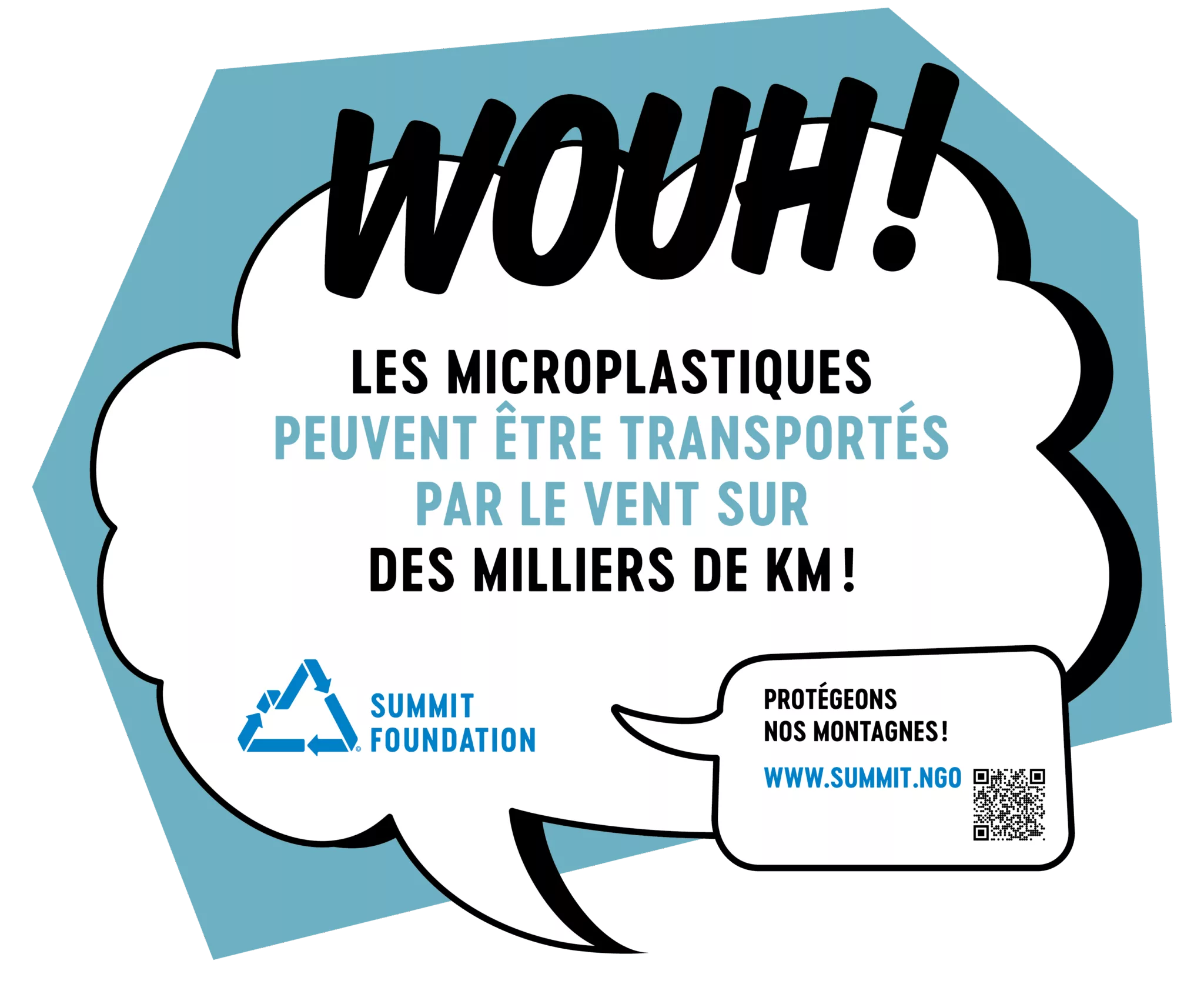
• Microplastics are plastics smaller than 5 millimeters, resulting from abrasion or fragmentation of larger plastics.
• Microplastics are ubiquitous in the environment and can be transported over thousands of kilometers.
• They act as vectors for pollutants, are toxic to wildlife, and can accelerate glacier melt.
EXPLANATIONS
Microplastics are plastic fragments whose size ranges between 5 millimeters and 1 micrometer. Today, they are ubiquitous in the environment and are a global concern.
Ils résultent de la fragmentation ou l’abrasion de plastiques plus grands (bouteilles, emballages, etc.) sous l’effet des UV, des forces mécaniques et des activités animales ou bactériennes. Les sources principales de microplastiques1 sont : l’abrasion des pneus, le littering (abandon des déchets dans la nature), la mauvaise gestion des déchets ou encore les fibres plastiques libérées par nos vêtements. Les microplastiques libérés s’accumulent dans les eaux et les sols.
Due to their small size and mass, microplastics can be transported by winds over thousands of kilometers2 and deposited in remote areas. The Clean Mont Blanc3 project, led by the Summit Foundation, AQUALTI and Université Savoie Mont-Blanc, has thus documented their presence in 18 glacial torrents of Mont-Blanc, even though they are far from human activities.
This contamination is not harmless and causes various environmental impacts:
- Microplastics carry persistent organic pollutants4 (POPs), coming from plastic additives or absorbed from the environment.
- They are ingested by wildlife5, 6. Their ingestion reduces feeding stimuli, causes digestive and reproductive disorders, and slows growth. The pollutants contained in microplastics accumulate in food chains.
- Finally, they help accelerate glacier melt7 by increasing the absorption of solar rays. They therefore increase the temperature at the surface of glaciers.
So what can you do? At your level, certain habits can help limit emissions:
- Reduce the use of plastic packaging and make sure it is recycled or disposed of properly.
- In the mountains, bring a bag for your waste, choose reusable containers, and a reusable water bottle instead of disposable bottles.
- In mountain restaurants and shops, encourage phasing out single use plastics in favor of sustainable alternatives.
Let’s adopt the right habits and protect our environment from microplastics.
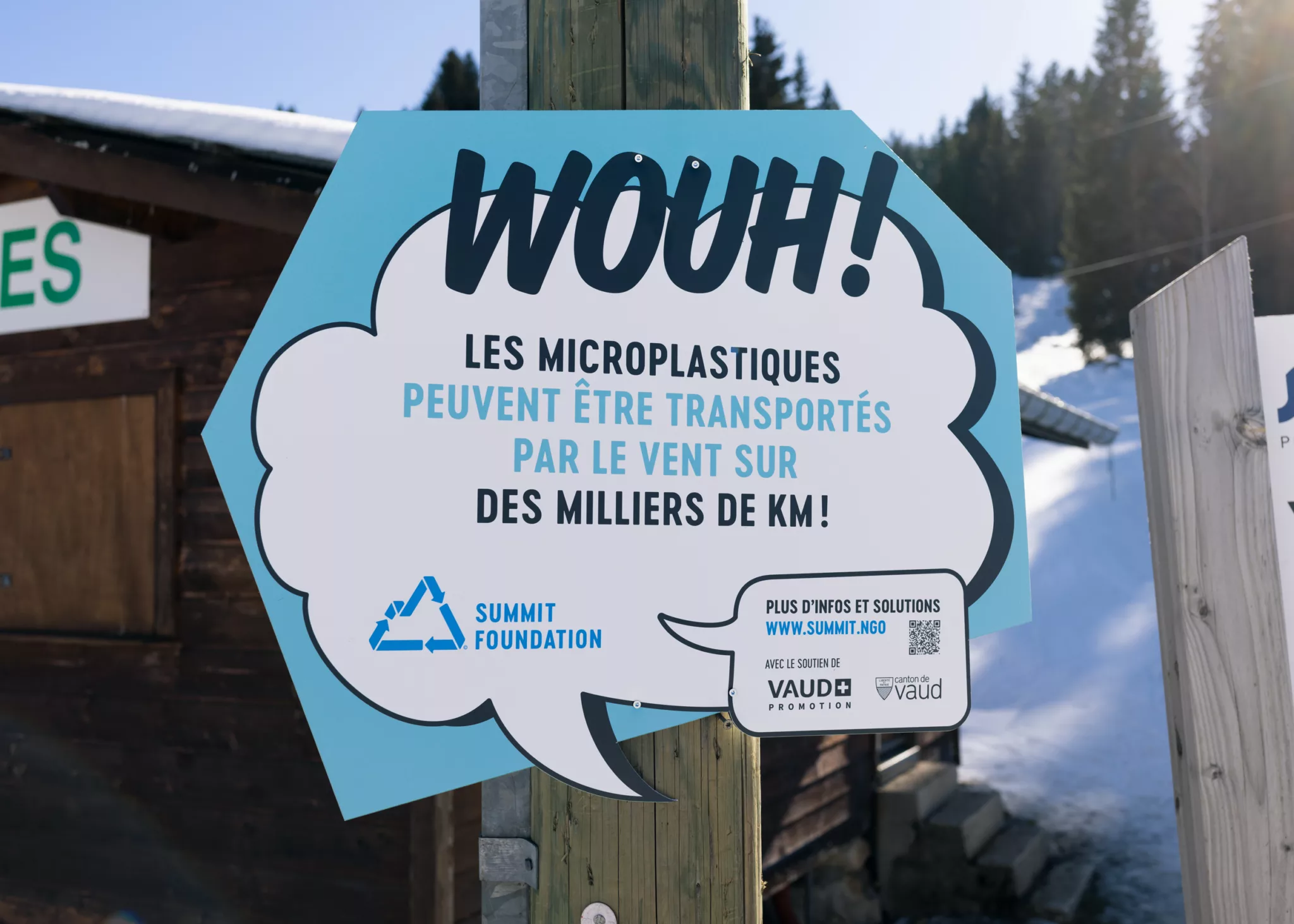
THE PFFFF! BUBBLE IN ACTION
SOURCES
- Padha, Shaveta, Rakesh Kumar, Anjali Dhar, et Prabhakar Sharma. « Microplastic Pollution in Mountain Terrains and Foothills: A Review on Source, Extraction, and Distribution of Microplastics in Remote Areas ». Environmental Research 207 (mai 2022): 112232. https://doi.org/10.1016/j.envres.2021.112232.
- Bergmann, Melanie, Sophia Mützel, Sebastian Primpke, Mine B. Tekman, Jürg Trachsel, et Gunnar Gerdts. « White and Wonderful? Microplastics Prevail in Snow from the Alps to the Arctic ». Science Advances 5, no 8 (2019): eaax1157. https://doi.org/10.1126/sciadv.aax1157.
- Clean Mont Blanc - Summit Foundation. s. d. Consulté le 10 septembre 2025. https://summit-foundation.org/en/clean-mont-blanc/.
- Gateuille, David, et Emmanuel Naffrechoux. « Transport of Persistent Organic Pollutants: Another Effect of Microplastic Pollution? » WIREs Water 9, nᵒ 5 (2022): e1600. https://doi.org/10.1002/wat2.1600.
- Bellasi, Arianna, Gilberto Binda, Andrea Pozzi, Silvia Galafassi, Pietro Volta, et Roberta Bettinetti. « Microplastic Contamination in Freshwater Environments: A Review, Focusing on Interactions with Sediments and Benthic Organisms ». Environments 7, no 4 (2020): 30. https://doi.org/10.3390/environments7040030.
- Susanti, N K Y, A Mardiastuti, et Y Wardiatno. « Microplastics and the Impact of Plastic on Wildlife: A Literature Review ». IOP Conference Series: Earth and Environmental Science 528, no 1 (2020): 012013. https://doi.org/10.1088/1755-1315/528/1/012013.
- Padha, Shaveta, Rakesh Kumar, Anjali Dhar, et Prabhakar Sharma. « Microplastic Pollution in Mountain Terrains and Foothills: A Review on Source, Extraction, and Distribution of Microplastics in Remote Areas ». Environmental Research 207 (mai 2022): 112232. https://doi.org/10.1016/j.envres.2021.112232.