
CLEANER MOUNTAINS

MIAM MIAM BUBBLE!

• Zigarettenstummel und Kunststoffe gehören zu den Abfällen, die am häufigsten in der Natur gefunden werden.
• Sie sind nicht biologisch abbaubar und enthalten zahlreiche giftige Stoffe.
• Sie bedrohen die Tierwelt stark durch Verschlucken und Verheddern, was zu Verletzungen, Vergiftungen oder zum Tod führen kann.
EXPLANATIONS
Cigarette butts and plastics are the most commonly found waste items in nature, and this holds true both at the global level1 and 2 at the Swiss level³. With the dozens of clean-ups carried out by the Summit Foundation as part of the Clean-Up Tour, we also note that the majority of abandoned waste consists of plastics or cigarette butts. In Switzerland, 14,000 tonnes of plastics⁴ end up in the environment each year, of which 2,700 tonnes are due to littering (the abandonment of waste in nature).
This pollution is problematic, because plastics and cigarette butts are not biodegradable⁵. Plastic can remain in the environment for several hundred years before disappearing. The same applies to cigarette butts, whose filter is made of cellulose acetate, a type of plastic. In addition, plastics contain additives, which are sources of pollutants for the environment⁶. It is even worse for cigarette butts, which contain more than 150 substances toxic to the environment⁷, including nicotine, arsenic, and heavy metals.
Plastic waste and cigarette butts are harmful to wildlife. In particular, animals can ingest them⁸, either unintentionally or by mistaking them for food. Such ingestion can have serious consequences for wildlife. It contaminates animals with the substances contained in the waste. In addition, ingesting plastic or cigarette butts can create a false feeling of satiety⁹, which leads animals to stop feeding and can result in their death. Furthermore, the ingestion of cigarette butts is not observed only in wildlife; it is also documented for domestic animals and young children¹⁰.
Another threat that plastics pose to wildlife is entanglement¹¹. Animals can become trapped in plastics, which can injure them, limit their ability to move, suffocate them, and thus lead to their death. This is mainly observed in marine species, but has also been observed in birds and freshwater species¹².
To reduce plastics and cigarette butts in the environment, remember to adopt the right habits:
• When out for a walk, bring a bag to carry your waste to the next bin.
• Limit the use of single use plastics (packaging, PET bottles, etc.). Choose a reusable water bottle and reusable containers instead.
• For smokers, remember to bring a pocket ashtray, such as the Ecobox offered by Summit Foundation.
Let’s be responsible and fight littering together to protect the wildlife of our mountains.
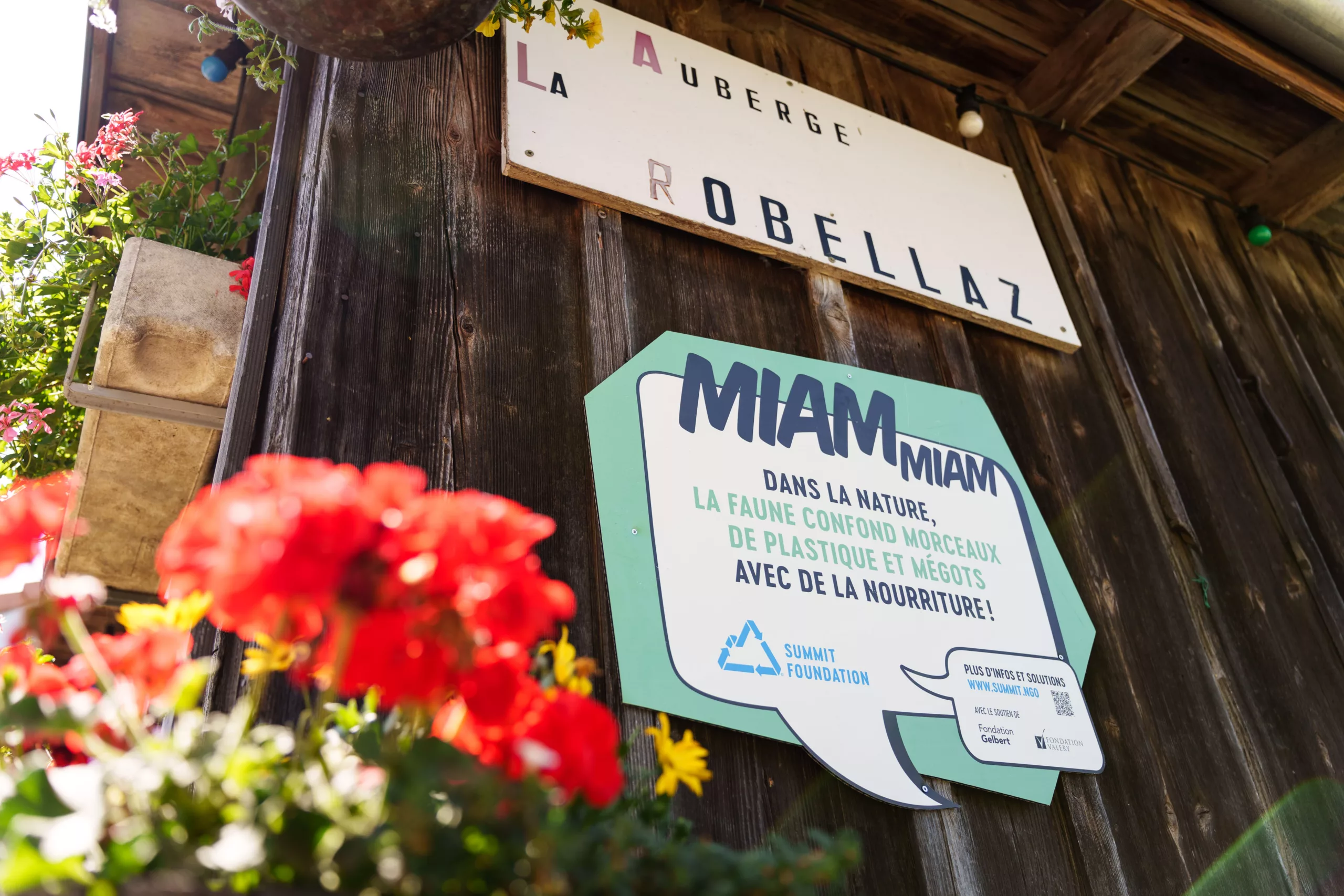
THE MIAM MIAM BUBBLE IN ACTION
SOURCES
- Vanapalli, Kumar Raja, Hari Bhakta Sharma, Shaivya Anand, et al. « Cigarettes Butt Littering: The Story of the World’s Most Littered Item from the Perspective of Pollution, Remedial Actions, and Policy Measures ». Journal of Hazardous Materials 453 (July 2023): 131387. https://doi.org/10.1016/j.jhazmat.2023.131387.
- Avio, Carlo Giacomo, Stefania Gorbi, and Francesco Regoli. «Plastics and Microplastics in the Oceans: From Emerging Pollutants to Emerged Threat». Marine Environmental Research 128 (July 2017): 2-11. https://doi.org/10.1016/j.marenvres.2016.05.012.
- FOEN, Federal Office for the Environment. « Waste along Swiss lakes and watercourses ». Accessed September 12, 2025. https://www.bafu.admin.ch/bafu/fr/home/themen/thema-abfall/abfall--dossiers/littering-schweizer-gewaesser.html.
- OFEV, Federal Office for the Environment. «Plastics in the environment». Accessed September 10, 2025. https://www.bafu.admin.ch/bafu/fr/home/themen/thema-abfall/abfallpolitik-und-massnahmen/kunststoffe-in-umwelt.html.
- Garcês, Andreia, and Isabel Pires. « The Detrimental Impacts of Plastic Pollution on Wildlife ». Research in Ecology, May 20, 2024, 42- https://doi.org/10.30564/re.v6i2.6294.
- Gateuille, David, and Emmanuel Naffrechoux. « Transport of Persistent Organic Pollutants: Another Effect of Microplastic Pollution? » WIREs Water 9, no.o 5 (2022): e1600. https://doi.org/10.1002/wat2.1600.
- Araújo, Maria Christina B., and Monica F. Costa. « From Plant to Waste: The Long and Diverse Impact Chain Caused by Tobacco Smoking ». International Journal of Environmental Research and Public Health 16, no.o 15 (2019): 2690. https://doi.org/10.3390/ijerph16152690.
- Napper, I. E., and R. C. Thompson. Plastics and the Environment. 2023. https://doi.org/10.1146/annurev-environ-112522-072642.
- Garcês, Andreia, and Isabel Pires. « The Detrimental Impacts of Plastic Pollution on Wildlife ». Research in Ecology, May 20, 2024, 42-46. https://doi.org/10.30564/re.v6i2.6294.
- Novotny, Thomas E, Sarah N Hardin, Lynn R Hovda, Dale J Novotny, Mary Kay McLean, and Safdar Khan. « Tobacco and Cigarette Butt Consumption in Humans and Animals ». Tobacco Control 20, no.o Suppl 1 (2011): i17-20. https://doi.org/10.1136/tc.2011.043489.
- Napper, I. E., and R. C. Thompson. Plastics and the Environment. 2023. https://doi.org/10.1146/annurev-environ-112522-072642.
- https://summit-foundation.org/shop/